Showing posts with label Caroline Palmer Clarke. Show all posts

Wednesday, November 16, 2011

Sarah Hale and the Campaign for a National Thanksgiving

The following article was contributed to the Clarke House Museum Blog by museum volunteer Steve LaBarre.

      Things are beginning to take on the appearances of the winter holidays here at Clarke House. With the upcoming Thanksgiving holiday fast approaching, I thought I would pause a moment to reflect on the history of the holiday during the time that Henry and Caroline Clarke lived in Chicago.


      Thanksgiving as we know it today took on a very different appearance during the early to mid-nineteenth century.  We currently celebrate the day on the fourth Thursday in November signed into federal legislation by President Franklin D. Roosevelt on December 26th, 1941.  A century and a half before this, on September 28, 1789, just prior to leaving for recess, the first Federal Congress passed a resolution asking then President George Washington to recommend to the country a day of thanksgiving.  Washington would issue a proclamation naming Thursday, November 26th, 1789 as a “Day of Publick Thanksgivin” – the first national Thanksgiving celebrated under the new Constitution.   

      From that time forth many presidents issued Thanksgiving proclamations, but the months and days on which it was observed varied greatly.[i]  As years passed, designation of the holiday was deferred to state-specific legislation.  States choosing to celebrate Thanksgiving would each select their own date of observance independent of the others. Most states celebrated Thanksgiving anytime between October and January- most likely based on the tradition of celebrating the year-end harvest.[ii]  Illinois was among several that regularly observed the holiday in November.

      This pattern of state-proclaimed Thanksgivings continued through much of the nineteenth century. Mrs. Clarke and the children would have read the Illinois governors' annual proclamation naming the date of Thanksgiving in local newspapers. Their relatives in New York would have celebrated the holiday on a completely different day. It wasn't long before a push to standardize Thanksgiving, declaring it a national holiday, began to take root among citizens of the United States. 

    Not until 1863, when President Abraham Lincoln signed a presidential proclamation declaring the last Thursday of November as the day of Thanksgiving, did the nation universally celebrate the holiday on the same day.[iii] So how did it come to pass that Abraham Lincoln wrote a proclamation claiming Thanksgiving to be a Federal holiday in November?  

Sarah Hale, c.1831 by James Reid Lambdin (1807-1889).
In the collection of Richard’s Free Library, Newport, New Hampshire .
           The story goes that a persistent lady by the name of Sarah Josepha Buell Hale (October 24, 1788 – April 30, 1879) was one of the influential forces in campaigning and persuading Lincoln to enact his proclamation.  Sarah Hale was an American writer and influential editor well known for her Poems for Our Children (1830), containing the well-known “Mary’s Little Lamb.”[iv]  She was born in Newport, New Hampshire on a farm belonging to her great-grandfather, Daniel Buell.     

Hale received no formal education, only what was taught to her by her mother an older brother, a student at Dartmouth, who taught her Latin and philosophy. When her husband died suddenly, in 1822, leaving her with little means to provide for herself and five children, she began to try her hand at authorship.  She published a volume of verse, The Genius of Oblivion (1823), and sent out numerous poems to local periodicals.  She won acclaim in 1826 for her novel, Northwood, A Tale of New England.  Two years later the Reverend John Lauris Blake offered her the editorship position of the Ladies Magazine, which began her active life as writer and promoter of conservative reform.[v]  While editing the Ladies Magazine in 1837 Louis Antoine Godey bought out the magazine and established Mrs. Hale as literary editor of the Godey’s Lady's Book.[vi]

      Just as many ladies of the mid-nineteenth century, Mrs. Clarke would have read frequently the latest issues of Godey’s Lady's Book.  She and her daughters could read about social and political thoughts of the day and reference the latest woman’s fashion plates advertising the styles direct from England and France.  One such article or editorial Caroline might have come across was in the January through June issue of 1847, volume 34.  On page, 174 Sarah Hale wrote:

                THANKSGIVING DAY.—We ventured to suggest, in our “Book” for January, that the last Thursday in November would be the day best suited for the Annual Thanksgiving holiday throughout our Republic.  The suggestion has been responded to in terms of approbation, and we trust the leading journals in the nation will give their aid to prepare for such a universal rejoicing next November.  That month of gloom would then become the gladdest in the year.[vii]

                Eleven years later Hale was still campaigning to establish recognition for the holiday.  Volume 57 from July – December 1858 states:
                                           OUR NATIONAL THANKSGIVING.
All the blessings of the fields,
All the stores the garden yields,
All the plenty summer pours,
Autumn’s rich, overflowing stores,
Peace, prosperity, and health,
Private bliss and public wealth,
Knowledge with Its gladdening streams,
Pure religion’s holier beams—
Lord, for these our souls shall raise
Grateful vows and solemn praise.

                We are most happy to agree with the large majority of the governors of the different States—as shown in their unanimity of action for several past years, which we hope, will this year be adopted by all—that The LAST THURSDAY IN NOVEMBER shall be the day of NATIONAL THANKSGIVING for the American people.  Let this day, from this time forth, as long as our Banner of Stars floats on the breeze, be the grand THANKSGIVING HOLIDAY of our nation, when the noise and tumult of worldliness may be exchanged for the laugh of happy children, the glad greetings of family reunion, and the humble gratitude of the Christian heart.  This truly American Festival falls, this year, on the twenty-fifth day of this month.
                Let us consecrate the day to benevolence of action, by sending good gifts to the poor, and doing those deeds of charity that wilt, for one day, make every American home the place of plenty and of rejoicing.  These seasons of refreshing are of inestimable advantage to the popular hear; and, if rightly managed, will greatly aid and strengthen public harmony of feeling.  Let the people of all the States and Territories sit  down together to the “feast of fat things, “ and drink, in the sweet draught of joy and gratitude to the Divine giver of all our blessings, the pledge of renewed love to the Union, and to each other; and of peace and good-will to all men.  Then the last Thursday in November will soon become the day of AMERICAN THANKSGIVING throughout the world. [viii]

Sarah Hale later in life, c.1855-60.
Her campaign for establishing Thanksgiving as a federal holiday lasted seventeen years. She began as early as 1846 imploring President Zachary Taylor, and subsequently Millard Fillmore, Franklin Pierce, and James Buchanan all to nationalize the holiday. [ix]  Her initial attempts failed to persuade, but the letter she wrote at age 75 to President Abraham Lincoln on September 28, 1863 seemed to have an influence none of the others had. After nearly two decades of dedicated prodding, Sarah Hale's wish for a national Thanksgiving Day came true. President Lincoln signed formal legislation finally establishing a national holiday of Thanksgiving for the American people through an official proclamation in 1863.

The Abraham Lincoln Papers at the Library of Congress
Series 1. General Correspondence. 1833-1916.
Sarah J. Hale to Abraham Lincoln,
Monday, September 28, 1863 (Thanksgiving Day)


[i] United States National Archives www.archives.gov/legislative/features/thanksgiving/ 11/14/2011.
[ii] Appelbaum, Diana Karter. Thanksgiving: An American Holiday, An American History.  New York, Facts on File, 1984.
[iii] Appelbaum, Diana Karter. Thanksgiving: An American Holiday, An American History. New York, Facts on File, 1984
[iv] Johnson, Allen & Malone, Dumas ed. Dictionary of American Biography Volume IV.  New York: Charles Scribner’s Sons, 1960: 111
[v] Johnson, Allen & Malone, Dumas ed. Dictionary of American Biography Volume IV.  New York: Charles Scribner’s Sons, 1960: 111
[vi] Johnson, Allen & Malone, Dumas ed. Dictionary of American Biography Volume IV.  New York: Charles Scribner’s Sons, 1960: 111
[vii] Godey, Louis Antoine & Sarah Josepha Buell Hale ed. Godey’s Lady's Book. Philadelphia: Louis A. Godey, Volume 34 from January – June 1847:  174.
[viii] Godey, Louis Antoine & Sarah Josepha Buell Hale ed. Godey’s Lady's Book. Philadelphia: Louis A. Godey, Volume 57 from July – Decemeber 1858: 463
[ix] Schenone, Laura. A Thousand Years Over A Hot Stove: A History Of American Women Told Through Food, Recipes, And Remembrances. New York: W. W. Norton & Company, 2004: 118

Monday, August 15, 2011

Charles Walker


In short, taking into consideration the varied incidents of his active life, his indomitable perseverance and industry, and the financial ability he has exhibited, Mr. Charles Walker has had few equals and no superiors, as a skillful business man and a good citizen.
-Chicago Magazine, March 1857

The Clarke family's relocation to Chicago in 1835 can be largely attributed to the persuasion of Charles Walker. Walker was Henry Brown Clarke's brother-in-law, married to his younger sister Mary (1805-1838). Charles Walker was born February 2, 1802 in Plainfield, Otsego County, New York. He was the oldest son of Colonel William W.  and Lucretia (Ferrel) Walker. Charles had limited education but was a quick learner. He  started school at age six in a log school house built by local farmers. Working his father's farm most of the year, Walker had only three months during the winter to devote to study, doing lessons with a teacher during the day and his parents in the evenings. By age fifteen he became a teacher himself, teaching local children during the winter months. At  eighteen, while still employed as a teacher, he began to study law. The sedentary lifestyle of an attorney did not bode well with Walker's active disposition so, upon the advice of physicians, he soon gave up the law choosing instead to travel the countryside as a livestock buyer for his father.

At age twenty-one his health began to diminish, presumably from excessive time outdoors, and he decided to hire himself out to a friend as a mercantile clerk. Within two months he had mastered the trade and opened his own business in Burlington Flats, New York May of 1824. He soon owned a grist mill, saw mill, potash factory, and tannery in addition to his mercantile. Walker married his wife, Mary Clarke May 8, 1827. He dealt successfully in grain, cattle, and other sundries until 1828 when a large shipment of cheese, butter, and pork, en-route to a southern market, was lost at sea. Walker suffered financially, but was able to grow his business back until 1832 when a decline in prices brought on another blow. Still determined to make it in trade, Walker continued to buy and sell in the New York market.  In spring 1833 he was able to turn a damaged cargo of raw hides from Buenos Aries into a profitable venture by making the leather into boots and shoes for fall Indian payments in Chicago. His brother Almond Walker took these, along with an assortment of guns, boots, shoes, and raw leather to Fort Dearborn in Chicago autumn of 1834.

Realizing the profit to be made out west, Charles Walker set out for Chicago himself in May 1835. Confident in the potential of Chicago as a center of commerce, he purchased several real estate lots, one at the corner of Clark and South Water Streets. Through a partnership with Captain Bigelow of Boston and Jones, King, & Co.Hardware, Walker bought the land for $15,000 cash. That spring he purchased hides in St. Joseph which he added to the other goods picked up in Chicago, which he sent back to New York. The total shipment was said to be the first from the state of Illinois to be sent as far east as Utica or Albany.

In June 1835 he returned to Chicago with his brother-in-law, Henry Brown Clarke. While Clarke purchased land for his own estate, Walker introduced him to local business associates which undoubtedly secured Clarke employment with Jones. King, & Co. when he returned with Caroline and their two sons in October. Walker also returned to Chicago in 1836 to establish the firm Walker & Co. with brother Almond Walker and brother-in-law Eri Baker Hurlburt, Esq (also spelled Hulbert, 1807-1852) a general store on South Water Street that dealt in importing animal husbandry implements and household goods from the east. Even with his primary business affairs in Chicago, Walker continued to reside in New York.

When the panic of 1837 hit Chicago, Walker was one of few who remained in business. He was able to satisfy his debts and keep a good reputation, which enabled him to actually grow his operations during a time of economic downturn. He used depreciated Western money, still accepted and circulated in Chicago, to purchase large quantities of goods, then shipped the items to his Eastern creditors as barter payment avoiding any transmutation of currency. Walker's success allowed him to help Henry and Caroline when they experienced financial trouble in the late 1830s, saving them from foreclosure on their house. Although financially secure, Walker experienced personal tragedy with the death of his wife Mary in June 1838. He was remarried in 1841 to Nancy Bently (d.1881) at Lebanon Springs, New York. His new wife and son Charles H. Walker (by Mary) left from Otsego County, New York and permanently took up residence in Chicago May, 1845.

Despite the assistance from Walker, Henry Brown Clarke declared bankruptcy in 1842. That same year Walker formed the firm Walker & Clarke in Buffalo with Henry's younger brother Cyrus Clarke, Esq. (1806-1884) of Utica, New York. Walker was chosen as a director for the Galena Railroad in 1847. Another financial crisis occurred the same year, this time in the grain trade, but Walker's ventures again endured so that by 1851 C. Walker & Son of Chicago (formed with his son), Walker & Kellog of Peoria, and Walker & Clarke of Buffalo were among the largest purchasers of grain from farmers in the United States. He served as second president of the Chicago Board of Trade from 1849 to 1851.

Ad for Walker & Clarke, 1853.

Charles Walker contracted cholera around 1851 and was forced to leave the management of his affairs to his son Charles. He recovered, but the toll of illness lead him to retire from business altogether in 1855. In 1856 he served as president and director of the Chicago, Iowa & Nebraska line, intended to be a continuation of the Galena railroad. Charles Walker died in Chicago June 28, 1869 leaving a lasting legacy as one of Chicago's early businessmen but more importantly, as a dear friend and devoted kinsman to the Clarke family.


Wednesday, August 10, 2011

New Acquisition: Pink Lustreware Tea Set

Pink lustreware tea service c.1820-30 now in the collection of The National Society of The Colonial Dames of America in the State of Illinois, housed at Clarke House Museum.
Clarke House Museum recently received an English pink lustreware tea service c.1820-30. The set is almost complete with eleven cups an saucers, cake plate, serving bowl, sugar bowl, and teapot.  The Staffordshire porcelain features a transfer print design accented by lustre banding.

Lustre is a form of decoration that can be applied to any form of ceramic goods, whether earthenware or porcelain. The design is formed in metal, then dissolved in acid and applied as a thin film on top of the glaze. This can be brushed on or applied through a dipping process.When fired, the oxidized metal in the lustre solution is reduced to its original metallic form. When gold was used as the lustre metal on a light colored background it took on a pink sheen, as seen in the pieces here.

Sugar bowl and Creamer
Lustre was often combined with transfer printing. The design was first engraved on a copper plate to which a warmed printing ink would be applied. The plate would be wiped leaving ink only within the engraved lines. Next the copper plate was pressed evenly into strong tissue paper, picking up a mirror image of the design. The tissue paper was then applied directly to glazed pottery or porcelain transferring the design to the piece. Next the object, with tissue still attached, was submerged in cold water to harden the ink and wash the paper away. Hand-applied enamel colors might then be applied before finally being fired in a kiln.

Teapot
Detail of Transfer Print

Nearly all fine china goods used in the United States during the early nineteenth century were imported from England. Mrs. Clarke might have received a tea service like this as a wedding gift upon her marriage to Henry Brown Clarke in 1827 and it is likely that the Clarkes owned at least one piece of lustreware when they set up house in Waterville, New York. This tea service will go on display in the study later this month. Be sure to look for it on your next visit to Clarke House Museum.

Tuesday, August 2, 2011

The Carpenter and the Maid

The Clarkes contracted John Campbell Rue as finish carpenter while constructing their stately Chicago home. Rue was born in Bath, Stuben County, New York March 23, 1809. He was the son of Joseph (c.1781-1820) of Albany New York and Mary Katherine Campbell Rue (b.1785) . John Campbell had a sister Adeline (c.1807- before 1810), and brother Schuyler (b.1816).

John Campbell Rue came to Illinois with his friend Ira Minard (1809-1876) in 1834. Rue considered buying property in Elgin and St. Charles, Illinois. He is recorded as fencing a farm in Elgin, possibly Sections 27 and 28 of Plato Township, Kane County that he is shown as owning in 1860. Rue decided to settle in Chicago a few months later, plying his trade as carpenter and builder. He is credited with helping to construct the town’s first breakwater. He is also said to have built Chicago's first newspaper office for his friend John Wentworth (1815-1888), editor, publisher, and later owner of the Chicago Democrat. 

The Clarke family had brought a domestic, Elizabeth “Betsey” Saunders, with them on their trip from New York. Betsy was born in Petersburg, Rensselaer County, New York in 1802. She was a distant cousin of the Clarkes and may have been hired for the family relation. She is mentioned in Mrs. Clarke’s November 1835 letter and would have been 33 years old when the family moved to Chicago. Betsy and John met during the construction of Clarke House, enjoyed a very brief courtship, and were married September 23, 1836. 

The Rue family claimed that John was never paid for his work on Clarke House, and worse, accused by the Clarkes of being a thief. Betsy's obituary from the January 5, 1895 edition of the Elgin Advocate states "In 1837 Mr. Clarke was among the many who were financially embarrassed and Rue on demanding his due was told that he didn't deserve anything, as he had entered his (Clarke's) home and robbed him of one of his jewels." Whether or not this is true, Betsy promptly left the employ of the Clarke family after her marriage to Rue and the couple took up residence on the 100 block of, coincidentally, Clark Street. The Rues had five children, three sons and two daughters: Mary (c.1837), Franklin (c.1838), Marcus (c.1840), John Ira (c.1843), and Anna Maria "Annie" (c.1845). 

Two of their sons, Marcus and John Ira, served in Company K of the 59th Illinois Infantry during the Civil War. They enlisted as privates September 1, 1861 and were mustered in September 6th to the 9th Regiment Infantry Missouri Volunteers (renamed Company K of the 59th Illinois Infantry Regiment in 1862). Marcus was born c.1840 in Chicago. At the time of his enlistment Marcus was 23 years old with light hair and blue eyes, standing 5'6" tall. He listed his occupation as carpenter. During his three-year term in service Marcus was engaged in Pea Ridge, the Siege of Corinth, Battle of Perryville, Stone's River (Murfreesboro), the Tullahoma Campaign, Lookout Mountain and Missionary Ridge (Chattanooga), the Atlanta Campaign, Buzzard's Root Gap, Resaca, Kennesaw Mountain, Peachtree Creek, and Jonesborough. He mustered out September 17, 1864.

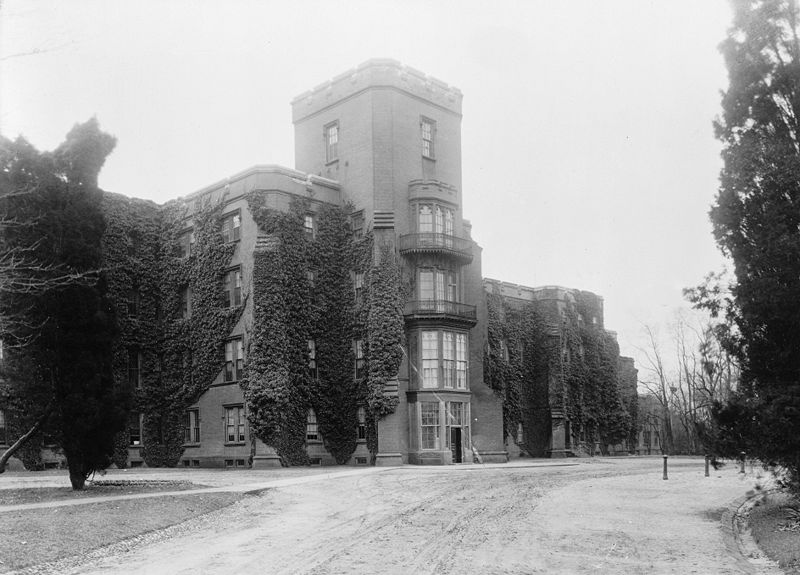
John Ira Rue was born 1843 in Chicago. He was 18 years of age upon enlistment with light hair and dark eyes, standing 5'-6" tall. He also gave his occupation as carpenter. John Ira was engaged in the Battle of Pea Ridge, the Siege of Corinth, and took wounds at Perryville, Kentucky which rendered him a patient at the  Government Hospital for the Insane in Washington D.C., renamed St. Elizabeth's Hospital in 1916. He lived out the rest of his life as a patient there until his death November 29, 1916. He was buried with military honors at Arlington National Cemetery.


Government Hospital for the Insane established 1855.The Hospital's early mission, as defined by its founder, the leading mental health reformer Dorothea Dix, was to provide the "most humane care and enlightened curative treatment of the insane of the Army, Navy, and District of Columbia."

The family lived in Chicago until the spring of 1887, relocating to Elgin where Rue continued the carpentry trade. He passed away at his home at 78 N. Crystal Street in Elgin, Illinois June 11, 1892. His funeral was held at 1p.m. on Monday June 13, 1892. He was buried in the family plot, Section 23, Lot 38 of the Plato Center Cemetery.
Elgin, Illinois around the time the Rue family relocated.


Upon his death, John Campbell Rue had an estimated $15,000 of real estate in Cook and Kane Counties. An attorney, a Mr. Ranstead, was appointed Executor of the Will. The heirs named to Rue's estate were wife Elizabeth, son John Ira, and grandaughter Emily W. Liddell (Annie's daughter).

Betsy lived three more years. She took sick December 9, 1894 and remained bed-ridden before dying January 30, 1895. She passed away at the home of her nephew, Ezra Rue (son of John's brother Schuyler), 120 N. Crystal Street, where she had lived, presumably, since John's death. Her funeral was held at 11 o'clock on Wednesday January 2, 1895. She is buried beside John in the family plot at Plato Center Cemetery.


Friday, June 17, 2011

New Acquisition: Niagara Falls Lithograph, 1827

Clarke House Museum is pleased to announce a new addition to the collection of The National Society of The Colonial Dames of America in the State of Illinois. Niagara Falls from the American Side is a hand-colored lithograph after an original sketch by French artist  Jacques G. Milbert, published in Paris in 1827. This drawing is from his "Itineraire Pittoresque du Fleuve Hudson" or Picturesque Route of the Hudson River, a series of sketches Milbert made in 1825 while he was in the United States surveying for the Erie Canal.

Henry and Caroline Clarke honeymooned at Niagara Falls following their marriage in 1827. According to daughter Caroline Clarke Forman, who filled out an Emma Willard School alumni survey form for her late mother, the Clarkes' travel companions were Mr. and Mrs. William H. Seward. Seward was the 12th Governor of New York, United States Senator and the United States Secretary of State under Abraham Lincoln and Andrew Johnson. Mrs. Seward had attended Troy Female Seminary (later renamed Emma Willard School) with her husband's sister, Cornelia. The relationship between the Sewards and Clarkes most likely came from a friendship formed between Caroline Palmer Clarke, Frances Miller Seward, and Cornelia Seward while attending school together as young women in the early 1820s.

The print, measuring 7 1/2" by 11 1/4 inches, will be placed in a period frame and hung in the Northwest Sitting Room at Clarke House Museum later this year.
William Henry Seward (1801-1872)  c. 1850
Frances Adeline Miller Seward (1805-1865) c.1844.

Thursday, May 19, 2011

Capturing Your Likeness: Ambrotypes of the Clarke Period

When the Clarkes arrived in Chicago from New York in 1835, the most common way to preserve the likeness of a loved one was through a painted portrait. While this would give you the general idea of what the person looked like, it was not an exact representation. By the 1850s photography had matured into a common method for capturing one's exact image.

Many images from the Clarke period are ambrotypes, from Ancient Greek word for “immortal” or “impression”. The ambrotype uses the wet plate collodion process, invented by Frederick Scott Archer (1813-1857) of England, to generate a negative image on a sheet of glass. Archer's process was adapted by James Ambrose Cutting (1814-1867) of Boston in 1854, who took out several patents in the United States and used the plate image produced as a positive, rather than a negative.
Cased ambrotype from the collection of The National Society of The Colonial Dames of America in the State of Illinois, housed at Clarke House Museum

Ambrotypes are produced by covering a small pane of glass with a thin layer of collodian dipped in silver nitrate. The sitter is positioned by the photographer and the wet plate is inserted into a camera. The plate is exposed to the light from five to sixty seconds depending on lighting conditions, developed, and fixed. The resulting image is, in fact, a negative. However, when placed against a dark background it appears to be a positive image. Areas of clear glass are viewed as dark because of the backing and the exposed areas, opaque because of the effects of the chemical solution, appear light.

Images of this type were often coated with black paint or varnish or placed against black paper or cloth. This can be done to either the emulsion-coated side of the plate or the clean glass. If the clean glass is backed, the thickness of the glass and emulsion produce an illusion of depth.

The back of the glass plate, coated in black paint or varnish.

From that point, the image could be hand-tinted with pigments. Most often cheeks were tinted a rosy pink and the jewelry accented in gold. For those who could afford a bit more color, whole garments could be tinted to give the portrait an even more realistic appearance.
Jewelry accented with gold paint
To preserve the ambrotype, the varnished and tinted plate was placed in a case with a decoratively pressed copper mat directly against the image. This was covered by a clear plate of glass and secured inside a velvet-lined case. These small tokens of loved ones were precious and cherished by families for generations.

Over time, climate conditions such as high humidity can break down the emulsion on an ambrotype. The  image below is "burned out." The adverse effect of improper storage or poor weather conditions has caused the emulsion to pull away from the glass plate or discolor.

Emulsion failure. Ambrotype from the collection of The National Society of The Colonial
Dames of America in the State of Illinois, housed at Clarke House Museum.
 Regardless of condition, ambrotypes are an invaluable historic resource. They provide concrete documentation of what people looked like, how they dressed, and what items they felt were important enough to capture in an image. We use ambrotypes like these  to help us interpret the life of Mrs.Clarke and her children in 1850s Chicago.

The Clarkes' younger daughter, Caroline, probably dressed like these girls. Ambrotype from the collection of The National Society of The Colonial Dames of America in the State of Illinois, housed at Clarke House Museum.

Tuesday, May 10, 2011

Robert George Clarke

Please note that research on the Clarke family is ongoing and this article reflects the most current documentation held by the museum. Text is subject to change as additional information becomes available and is interpreted by Clarke House Museum staff. 

Robert George Clarke, sixth child of Henry and Caroline Clarke, was born May 10, 1838 at the family home in Chicago. He came of age during the time the Clarkes were suffering from financial trouble associated with the Panic of 1837. As a boy Robert would have helped his father, Henry B. Clarke, with the family's dairy farming operation. Robert was just eleven years old when his father died of cholera in 1849 and seventeen when Caroline Clarke, his mother, completed the modifications to the house in 1855.

When Caroline Clarke passed away in January 1860, Robert took over as head of household. Even though his older sister Mary and her husband Frank Williams were present to help care for the family, Robert was the eldest surviving Clarke male (older brother Henry James died in 1856) and took responsibility for holding things together. At the time of the 1860 U.S. census Robert was twenty-one and working as a book keeper. His personal estate was valued at $1000.

Robert Clarke was successful in his business partnership, Palmer & Clarke, with brother-in-law Frank Williams (husband of Mary Clarke) and uncle Charles D. Palmer (Caroline's brother). They dealt in animal hides, furs, and wool. The 1867 Chicago City directory list Robert as working in the firm and still living with his siblings at Clarke House, listed as 596 Michigan Avenue. It was around this time that Robert Clarke  began courting his future bride Clara Gage.

Clara was born June 15, 1848 in Keene, Cheshire County, New Hampshire to David A. Gage (1822-1889) and Faustina Mulliken Locke (1819-1850). At the time of the 1850 census Clara's father ran a successful hotel and boarding house in Rockingham, Windham County, Vermont. Unfortunately, her mother died just months later in November 1850 when Clara was only two years old. Her father soon remarried to Eliza N. Wetherbee (c.1829-1894). The Gage family moved in with Eliza's father, Isaac Wetherbee (1797- ?) following the death of her mother in September 1859.

Clara's father was a shrewd and ambitious businessman. In 1860 he took his wife and daughter, along with older brother George W. Gage (1812-?)  to Chicago where they boarded at the Tremont House in July of that year. David and George Gage met and formed a business connection with hotelier John Burroughs Drake (1826-1895), part owner of the Tremont from 1855-1871. By 1862 they had formed the firm of Gage Bros. & Drake. David A. Gage also became superintendent of the Chicago Horse Rail Road. Two years later Gage had formed another partnership Gage, Waite, & Rice and had moved his family to the Shermon House at the northwest corner of Clark and Randolph of which his new company was the proprietor. David A. Gage is listed in the Chicago City Directory as residing at the Sherman House from 1862-1871.

Sherman House, 1858. Photograph by Alexander Helsler.  Robert Clarke's wife, Clara Gage, lived at this hotel with her father and stepmother from the time they met until their marriage in 1868. Image courtesy of Chicago History Museum.

It is unknown where or when Clara and Robert met. They both had lost parents and this may have been one of the shared experiences that drew them together. They both also came from well-established and, at least initially, well-do-do New England families. In 1860s Chicago, theirs would be considered a good match.

A week before their wedding date, Robert applied for a passport for his honeymoon trip with Clara abroad. See Robert Clarke's 1868 passport application. The couple married November 15, 1868 and took up residence at the Clarke family home at 596 Michigan Ave. Robert continued to work for Palmer & Clarke. In 1870, Clara and Robert had established their own home just down the street, next door to Clarke House at 604 Michigan Avenue. Robert, now a successful cattle broker, had grown his modest finances to a personal worth of $25,000. Clara herself held $50,000 in real estate and $2,000 in personal assets. The couple lived quite comfortably with an Irish domestic servant named Bridget Bigley.

The Great Chicago Fire of 1871 devastated the downtown Chicago hotel district, but did not reach the near south side where the Clarkes were living.  The Sherman House was laid to waste by the fire so, presumably, Clara's parents stayed with her and Robert in the months immediately following while the city scrambled to rebuild. In addition to ownership in Gage Bros. & Rice and the Frank Parmalee omnibus company, Robert's father-in-law, David A. Gage, had been elected Chicago City Treasurer in 1870. Gage was also appointed treasurer of the General Relief Committee following the fire, given charge over all monetary aid contributions sent to the city. On October 28, 1871, however, the Chicago Republican reported "there are anxious inquires concerning Mr. David Gage's use of the city funds since he has been Treasurer. Will he rise to explain?" Suspicion of illicit practices cast a dark shadow of the Gage-Clarke family and city authorities began to investigate where the money was going.

Chicago in ruins, 1871. With the Sherman House obliterated, Clara's parents probably stayed her and Robert following the Great Chicago Fire.


Clara gave birth to the couple's only child, son David Gage Clarke (named for her father), on March 25, 1872. Just a few months later Robert oversaw the sale of his childhood home to the Chrimes family. Robert could watch from his own front stoop as the mighty columns of his parents' Greek Revival mansion were removed and the house was jacked up then carted off by horses to 4526 S. Wabash Avenue in what was then the town of Hyde Park. With the old Clarke family home gone, Robert turned his attention to his own young family and their future.

Clara's parents soon returned to hotel living. Gage Bros.& Rice now operated the Grand Pacific Hotel, on Clark Street between Quincy and Jackson, which reopened in 1873. David A. Gage was not reelected City Treasurer and for good reason - he was at the center of an extraordinary scandal.  In December 1873 it was determined that Gage had grossly misappropriated city funds and the treasury was deficient to the tune of $508,703.58.  Read more about David A. Gage and his defalcation scandal here, beginning on page 856.  Disgraced by the embezzlement scandal, Clara's father and stepmother seem to have retreated to the comfort of family and are found in residence at the Clarkes' 604 Michigan Avenue house according to the 1875 and 1877 Chicago City Directory. David A. Gage is not listed as having any profession, a telling sign of his utter dismissal from the realm of Chicago business.

During the tumult occurring with his father-in-law, Robert seems to have tried to lead a normal life. By 1874 Palmer & Clarke appears to have dissolved and Robert is listed as working for C. L. Goodman & Co., a Chicago bread and cracker manufacturer which touted its "building [was] erected in the Burnt District and business fully resumed in 37 days after the fire of Oct. 8th and 9th, 1871."

From Cattle to Crackers: Advertisement for C. L. Woodman & Co. from The Railroads of Chicago. Chicago: The Western News Company, 1872. Robert Clarke is listed as working for this company in the 1874 Chicago City Directory.

In 1878 Robert had once again changed careers and is listed as manager of Anderson's Refrigerator Line and Coal Storage Company and, interestingly, boards at the Palmer House Hotel. The narrative given about his father-in-law in History of Chicago by Alfred Theodore Andreas mentions the Gages deeded property as payment for their debt. Further research is needed, but it is possible Robert and Clara's home at 604 Michigan Avenue could have been part of this land.

Gold had been discovered in Colorado in the 1870s and Americans rushed west to make their fortunes. Clara's father decided to escape his sullied past in Chicago and take on a new business venture in Denver, Colorado. David A. Gage and Michigan-born businessman Alexis M. Lay (1845-1921) formed the partnership Gage & Lay which ran the Grand Central Hotel at the intersection of Lawrence and 17th Streets in Denver. The1880 census lists Clara, her stepmother Eliza, and son David in residence with David A. Gage.  Robert's youngest brother Cyrus Clarke is also living in Denver in 1880, working as a miner. Robert Clarke was living away from his family working as a laborer and residing at 402 East 8th Street in Leadville. In 1881 Robert is listed as a clerk for the Little Chief Mining Company living at 123 East 4th Street in Leadville.

Grand Central Hotel, Denver, Colorado c.1880. Robert Clarke's wife and son lived at this hotel operated by his father-in-law, David A. Gage. Image courtesy of Denver Public Library Digital Collections.


Stock certificate for the Little Chief Mining Company in Leadville, Colorado.

Mines in Leadville, Colorado at the time Robert worked for the Little Chief Mining Company. Photo courtesy of www.miningartifacts.org.

Work was hard and days were long. Robert Clarke distinguished himself and went on to became the manager of the Gold Cup Mine in Tin Cup, Colorado. In 1896 Robert obtained a lease on the property. Unfortunately, three weeks later, he died  tragically in a mining accident on December 9, 1896 at the age of 58.

His death is described in Stampede to Timberline: Ghost Towns and Mining (1949) by Muriel Sibell Wolfe:

Three weeks after he took it [Gold Cup Mine] over it was still so early in the season that he and three other men improvised a toboggan with which to get down and up the ice-coated incline of the mine tunnel. One morning they started down as usual, but three hundred feet below the surface the toboggan caught on some caved-in rock. Three of the men jumped to safety and signaled the engineers to stop the hoist; but Clark [sic] stayed on the sled and succeeded in working it loose. Fifty feet of slack cable connected it to the hoist, and as the toboggan gathered speed Clark [sic] was unable to leap off. When the slack was taken up the sled stopped suddenly, throwing Clark [sic] headlong down the tunnel to his death.

Denver Republican. December 11, 1896.


Chicago Daily Tribune. December 10, 1896.

Robert's body was shipped from Tin Cup to Denver then returned to Chicago where he lay in state at sister Caroline Clarke Forman's home before being laid to rest at the Clarke family plot in Graceland Cemetery.

Clara and David remained in Chicago for many years following Robert's death. Later they are found living in Kansas City, Missouri where Clara died February 28, 1938. She was cremated and her remains were interred with Robert at Graceland. Their only son, David Gage, married a woman named Kathryn between 1930 and his own death March 11, 1944. The couple had no children. David too was cremated and placed in the Clarke family plot at Graceland Cemetery, Chicago along with his mother and father, Robert George Clarke.

Wednesday, February 16, 2011

St. Paul's Congregation Continues to Make News

Throughout the 1950s, Bishop Ford and the congregation of St. Paul Church of God in Christ continued to make improvements to and advocate the preservation of Clarke House at its 4526 S. Wabash Avenue location. As we continue to celebrate Black History Month, please enjoy the following excerpts from articles in the Clarke House Museum archives:

PARTY TO HELP PAY REPAIRS TO HISTORIC HOUSE
Chicago Tribune December 30, 1951

The Congregation of St. Paul Church of God in Christ, 4532 Wabash av., will hold a benefit musical program and New Year's eve service at 8p.m. tomorrow in Du Sable High School auditorium. The Rev. Louis H. Ford, pastor, said proceeds from the program will be used to pay for the repairs being made on the Widow Clarke house, 4526 Wabash av., the oldest residence in Chicago, which the church owns. The congregation has contributed more than $4,000 to rehabilitate the house.

The Rev. Ford, who now uses the residence as a parsonage, has directed the drive to gather funds for basic repairs of the plumbing system and roof and for painting the exterior of the historic home. He estimated that another $5,000 would be needed to complete repair work on the interior. He said he hopes to make the house a museum of early Chicago home furnishings and design.


HISTORIC HOUSE, LANDMARK IN CITY, BEGINS 121ST YEAR
Chicago Tribune August 27, 1956

The 120th anniversary of a Chicago landmark was celebrated yesterday at 4526 Wabash av., where the city's oldest known home stands. It is the "Widow Clarke" house, built about 1836 at 18th st. and Wabash av. in the Greek revival style.

The 14 room white frame building is a reminder that old dwellings need not be dilapidated, said the Rev. Louis Henry Ford, present occupant. The birthday celebration was planned to demonstrate the importance of property conservation, he said.

The Rev. Mr. Ford is pastor of St. Paul Church of God in Christ, next door at 4532 Wabash av. The church purchased the historic house for $7000 in 1940 as a parsonage. Since then, more than $15,000 has been expended in rehabilitating the old building, said the pastor.

Siding Is Replaced
Deteriorated roofing and siding were replaced, foundations repaired, and modern plumbing installed. The building, supported by its original rough hewn oak beams, looks better than many houses constructed in the last decade, said Rev. Mr. Ford.

A birthday tea attended by city officials and hundreds of neighbors was held on the parsonage lawn to mark the event. Parked in Wabash av. was such city cleanup equipment as garbage trucks, street sweepers, and a rat control demonstration truck. The display of vehicles was intended to encourage citizens in neighborhood conservation.

Notable Mansion
The house was constructed by Henry Brown Clarke, an early Chicago hardware dealer and banker. The building was one of the city's notable mansions. Four [two] pillared porticos were at the front and rear of the building. The removal of these porticos is the only major change in appearance of the house. Their replacement, a future goal of the church, would cost an estimated $24,000.

After the Chicago fire of 1871, Clarke's widow sold the house, which was moved to the present location. Replacement value of the landmark is estimated at $50,000. Four spacious rooms on the first floor and four on the second floor have their own fireplaces, with original mantles. Most of the house's original cherry doors are in place. Ceilings are 12 feet high.

The house was one of three in Chicago to be blueprinted by the federal historic Americans buildings survey. The blueprints were recorded in the Library of Congress in 1932.
Related Posts Plugin for WordPress, Blogger...