Tuesday, July 5, 2011

A Taste of History: Recipe of the Week #4

All recipes featured in A Taste of History are taken from Modern Cookery, In All Its Branches edited by Mrs. S. J. Hale, 1852 from the collections of The National Society of The Colonial Dames of America in the State of Illinois housed at Clarke House Museum.


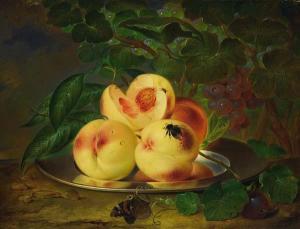
Still Life With Peaches, Grapes, and Insect by Theodor Mattenheimer, 1834.

Peach Salad
Pare* and slice half a dozen fine ripe peaches, arrange them in a dish, strew them with pounded sugar*, and pour over them two or three glasses of champagne*: other wine may be used but this is best. Persons who prefer brandy can substitute it for wine. The quantity of sugar must be proportioned to the sweetness of the fruit.

Modern Conversions
*pare = peel
*pounded sugar = confectioner's/ powdered sugar
*sparkling grape juice may be substituted for champagne for the temperant or youthful

Friday, July 1, 2011

New Acquisitions: Drying Racks


Clarke House Museum has just acquired two circa 1850 wood drying racks. The pieces were purchased by The National Society of The Colonial Dames of America in the State of Illinois from a source in Maryland. Both are painted pine with simple lines and carved feet. The Clarkes would have hung towels or herbs to dry behind the kitchen stove and Mrs. Clarke may have used a rack for towels in her bed chamber. Check out these new pieces on your next visit to Clarke House Museum.
 

Wednesday, June 29, 2011

A Taste of History: Recipe of the Week #3

All recipes featured in A Taste of History are taken from Modern Cookery, In All Its Branches edited by Mrs. S. J. Hale, 1852 from the collections of The National Society of The Colonial Dames of America in the State of Illinois housed at Clarke House Museum.

Common Lemon Tartlets
Beat four eggs until they are exeedingly light, add to them gradually four ounces of pounded sugar*, and whisk these together for five minutes; stew lightly in, if it be at hand, a dessertspoonful* of potato flour, if not, of common flour well dried and sifted; then throw into the mixture, by slow degrees, three ounces* of good butter, which should be dissolved, but only just luke-warm; beat the whole well, then stir briskly in the strained juice and the grated rind of one lemon and a half. Line some pattypans* with fine puff-paste* rolled very thin, then fill them two thirds full, and bake the tartlets about twenty minutes, in a moderate oven.

*Instead of puff paste, try Miss Acton's recipe for :  
Very Rich Short Crust for Tarts 
 Break lightly, with the least possible handling, six ounces of butter into eight of flour; add a dessertspoonful* of pounded sugar*, and two or three of water; roll the paste for several minutes, to blend the ingredients well, folding it together like puff-crust, and touch it as little as possible.

Modern Conversions
*three ounces = aprx. 1/3 cup
*four ounces = 1/2 cup
*pounded sugar = confectioner's/ powdered sugar
*dessertspoonful = aprx. 1/2 tablespoon
*pattypans = use cupcake pans

Tuesday, June 21, 2011

A Taste of History: Recipe of the Week #2

All recipes featured in A Taste of History are taken from Modern Cookery, In All Its Branches edited by Mrs. S. J. Hale, 1852 from the collections of The National Society of The Colonial Dames of America in the State of Illinois housed at Clarke House Museum.

Stay cool as a cucumber with this tasty 1850s recipe!
Mandrang, or Mandram; (West Indian Receipt.)
Chop together very small, two moderate-sized cucumbers, with half the quantity of mild onion; add the juice of a lemon, a saltspoonful or more of salt, a third as much cayenne, and one or two glasses of Maderia, or any other dry white wine. This preparation is to be served with any kind of roast meat.

Modern Conversions
saltspoonful = aprx. 1/2 tsp.

Friday, June 17, 2011

New Acquisition: Niagara Falls Lithograph, 1827

Clarke House Museum is pleased to announce a new addition to the collection of The National Society of The Colonial Dames of America in the State of Illinois. Niagara Falls from the American Side is a hand-colored lithograph after an original sketch by French artist  Jacques G. Milbert, published in Paris in 1827. This drawing is from his "Itineraire Pittoresque du Fleuve Hudson" or Picturesque Route of the Hudson River, a series of sketches Milbert made in 1825 while he was in the United States surveying for the Erie Canal.

Henry and Caroline Clarke honeymooned at Niagara Falls following their marriage in 1827. According to daughter Caroline Clarke Forman, who filled out an Emma Willard School alumni survey form for her late mother, the Clarkes' travel companions were Mr. and Mrs. William H. Seward. Seward was the 12th Governor of New York, United States Senator and the United States Secretary of State under Abraham Lincoln and Andrew Johnson. Mrs. Seward had attended Troy Female Seminary (later renamed Emma Willard School) with her husband's sister, Cornelia. The relationship between the Sewards and Clarkes most likely came from a friendship formed between Caroline Palmer Clarke, Frances Miller Seward, and Cornelia Seward while attending school together as young women in the early 1820s.

The print, measuring 7 1/2" by 11 1/4 inches, will be placed in a period frame and hung in the Northwest Sitting Room at Clarke House Museum later this year.
William Henry Seward (1801-1872)  c. 1850
Frances Adeline Miller Seward (1805-1865) c.1844.

Tuesday, June 14, 2011

A Taste of History: Recipe of the Week #1

Food is a common thread that connects us to our ancestors. Our lifestyles today may be very different from what was experienced by the Clarkes and others in 1850s Chicago, but just like us they used food as a means to socialize and express creativity.  Clarke House Museum has only one period cookbook in its collection, but it is a treasure-trove of culinary advice and interesting dishes. Modern Cookery, In All Its Branches: Reduced To A System of Easy Practice, For The Use of Private Families was written by Eliza Acton in 1845 for an English audience. The cookbook in our collection is a second edition (1852) of the version revised for American housekeepers by Mrs. S. J. Hale in 1845.

In the preface to the American edition Mrs. Hale writes:
I have often been surprised to observe how far behind the art of Cookery in the United States is behind the age. It was therefore with much pleasure that I undertook, at the request of the publishers, to superintend an American edition of this new work of Miss Acton, when on examination, I found how well it adapted to the wants of this country, at the present time.
The Preface of the Author is so complete, and explains so fully her wishes and motives in publishing, that I have little to add, except to state that, as the work is presented solely as a result of the Author's experience, it would have been inconsistent with the plan to make any additions. Therefore, the few which have been made, rather chiefly to the preparation of those articles which may be regarded as more strictly American: such as Indian Corn, Terrapins, and some others. Whatever revision has taken place, is in reference to the use of a few articles and terms not generally  known here, for which sunstitutes are presented, so as to adapt the work to this country. The additional matter will be found distinguished by brackets [-].
This work has been so well received in England, as to have already passed to a second edition; enjoying the universal approbation of the press, and the general favour of the public. I cannot feel persuaded that, when known, it will provide equally satisfactory to the housekeepers of this country, and find its way into the hands of all who wish to improve the Art of Cookery.
S. J. H. Philadelphia, 1845
This 1852 edition at Clarke House Museum is signed in three places by Jane E. Rose who may have been the original owner of the book.

In an effort to connect the past with the present, Clarke House Museum  introduces A Taste of History, a weekly recipe feature here on the Clarke House Museum Blog. Look for a different recipe from Miss Acton and Mrs. Hale each week!  Tips on converting period measurements to modern-day standards will be given, but part of the fun is experimenting with what our ancestors used. We hope you'll enjoy this weekly feature. Feel free to share your experiences in the comments section following the blog post. Bon Appetite!

A Taste of History: Recipe of the Week #1

Common Carrot Soup 
The easiest way of making this soup is to boil some carrots very tender in water slightly salted; then pound them extremely fine, and to mix gradually with them boiling gravy-soup (or buillion), in the portion of a quart to twelve ounces of carrot. The soup should then be passed through a strainer, seasoned with salt and cayenne, and served very hot.
Soup, 2 quarts; pounded carrot, 1 ½  lb.; salt, cayenne: 5 minutes.

Modern Ingredient Conversion
2 quarts boiling soup gravy = 4 cups chicken stock
12 ounces pounded carrots = 1.5 cups processed/blended carrots

Monday, June 13, 2011

"A Walk Through Time": A Great Success!

Docent Aimee Daramus interprets in the parlor during the 2:00 tour.
Clarke House Museum was one of ten historic sites featured during "A Walk Through Time"- Glessner House Museum's annual house walk benefit on Sunday June 12, 2011. We enjoyed wonderful weather and even better attendence. In addition to Clarke and Glessner House Museums, the walk included Second Prebyterian Church and seven privately owned Prairie Avenue District residences: the William W. Kimball House (1892), Joseph G. Coleman House (1886), Elbridge G. Keith House (1870), the Calvin T. Wheeler Mansion (1870), Dr. Charles W. Purdy House (1891), Harriet F. Rees House (1888), and the William H. Reid House (1894).

Close to 100 people came for a 30-minute tour of the first floor, kitchen, and orientation gallery at Clarke House Museum during the three-hour program. Tours were offered on the hour and half-hour from 1-4pm. Docent Aimee Daramus, Assistant Curator Becky LaBarre and husband Steve LaBarre dressed in period clothing to represent the look of the 1850s. The presentation reinforced the social themes of paying calls and typical room use of the period. Guests asked great questions and everyone enjoyed an afternoon of touring homes in the Prairie Avenue Historic District. "A Walk Through Time" is an annual event, so if you weren't able to attend this time please join us next year!
Assistant Curator, Becky LaBarre, museum volunteer Steve LaBarre, and docent Roberta Siegel in the
Glessner House Museum coach house before the start of "A Walk Through Time."

Period outerwear on the bench near the Indiana Avenue entrance echoes the theme
of calling on neighbors. Close to 100 people paid a call to Clarke House during Sunday's program.
Related Posts Plugin for WordPress, Blogger...